2026 Report on Automated Sorting Systems
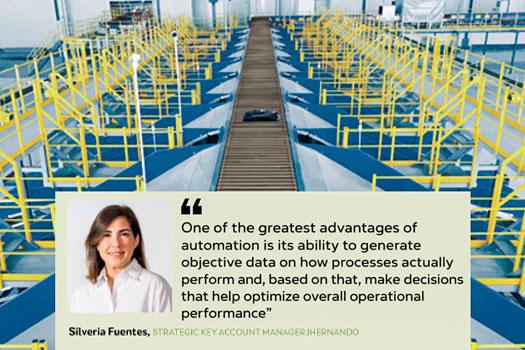
Once again, the Spanish magazine Logística Profesional has included the expert perspective of JHernando and Silveria Fuentes, Strategic Key Account Manager at JHernando, in its special report on automated sorting systems, published in issue 312 for June/July 2026.
The report takes a closer look at the trends shaping today’s intralogistics sector, with a particular focus on sorters and the role they now play in increasingly demanding, fragmented and time-sensitive operations.
Below, Silveria Fuentes shares JHernando’s view on how sorting systems are evolving and how companies are approaching automation investment with greater strategic focus.
Questions
- Traditionally, the focus was on speed and capacity. Today, to what extent does the real competitive edge lie in the intelligence of the system itself, including software, algorithms and real-time decision-making?
- How are you adapting your solutions to environments where orders are becoming increasingly fragmented, multi-format and subject to ever-faster delivery requirements?
- What type of data do these systems generate, and how can companies use it to improve decision-making and operational efficiency?
- One of the long-standing challenges has been implementation time. Are project timelines becoming shorter? How is this being addressed?
- How is the way companies approach investment in automation evolving? Is there growing demand for more flexible models?
1. System intelligence as a real competitive advantage
Speed and capacity have traditionally been the two concepts most closely associated with sorting systems. However, they do not always go hand in hand. A system can operate at high speed and still fail to deliver maximum productivity.
For that relationship to work properly, engineering judgement is essential. The control logic must be well designed, aligned with the customer’s operation and able to make the right decisions at the right time. That is why, today, system intelligence and control have become truly decisive factors.
This is precisely where JHernando brings value: combining experience, technical expertise and operational know-how to design, manufacture and integrate sorting systems that do much more than move products quickly. They apply the right logic, adapt to the operational context and help maximise the real performance of the installation.
A clear example of this approach can be seen in JHernando’s own sorters, as well as in the 3D sorter from our partner Mushiny, for which JHernando is the distributor in Spain and Portugal. This compact solution is particularly well suited to multi-line order preparation, returns and replenishment processes, especially in operations where space is at a premium.
2. Adapting sorting systems to today’s operational reality
For JHernando, adapting solutions to each operational environment is not a reaction to the latest market demands. It is part of the company’s DNA and has been for 60 years.
The starting point has always been clear: no two operations are the same. That principle is more relevant than ever in today’s logistics landscape, where companies are dealing with increasingly fragmented orders, a broader variety of product formats, growing reverse logistics volumes and ever-tighter delivery requirements.
At the same time, there is no need to reinvent the wheel with every project. The real balance lies in adapting proven modules and technologies, both in-house and from specialist partners, to configure the solution that best fits each operational flow.
This may involve pop-up sorters, tilt-tray sorters, cross-belt sorters or other sorting systems tailored to each customer’s volumes, product mix, space constraints and business priorities. The real value lies in integration engineering: selecting, adapting and implementing the right technology so that it responds effectively to the customer’s actual business needs.
3. The data generated by modern sorters
From an operational point of view, it is difficult to improve what cannot be measured.
One of the major advantages of automation is its ability to generate objective data on how processes actually behave. This allows companies to make better decisions and optimise overall operational performance. By automating the sorting process, businesses can obtain data on virtually any relevant variable. In standard terms, some of the most valuable indicators include real throughput, line occupancy, outlet saturation, rejected items, reading or classification errors, and behavioural patterns during peak demand periods.
This information can be used to size resources more accurately, adjust work shifts, detect potential bottlenecks, reorganise routes and anticipate maintenance actions.
In addition, sorting systems can also generate data that delivers direct economic value to the business, such as parcel type, weight and dimensions.
4. Brief implementation times, without compromising operations
Implementation times are becoming shorter. This is partly because manufacturers and integrators have adapted the way they work in response to a far more uncertain global environment. The geopolitical situation of recent years has forced the sector to plan further ahead, anticipate potential supply chain disruptions and manage project risks more effectively.
In JHernando’s case, having its own manufacturing capabilities in Spain provides an additional advantage. It allows the company to pre-assemble equipment and move forward in parallel with civil works, reducing dependence on external deadlines and shortening the overall project execution time.
However, in automation projects, the real challenge is not simply to do things faster. The key is to do them while minimising the impact on the customer’s day-to-day operation, especially when working on extensions or integrations within existing facilities.
This is where careful planning, modular solutions and well-coordinated engineering truly make the difference.
5. More flexible automation investment models
The way companies approach investment in automation has evolved towards a much more strategic mindset.
JHernando is seeing customers place greater emphasis on clearly justifying each project, understanding the expected return and preserving the flexibility needed to respond to future market changes that may affect their operations.
In this context, modular and scalable solutions are becoming increasingly important. They allow companies to automate in phases, validate performance and grow progressively as business needs evolve, rather than committing to large upfront investments based solely on long-term forecasts.
That is exactly JHernando’s approach: designing sorting systems adapted to each operation, with the flexibility required to meet current needs without limiting the customer’s ability to evolve in the future.
As intralogistics continues to change, sorters are no longer viewed simply as high-speed equipment. They are becoming intelligent and strategically integrated systems that help companies build more efficient and scalable operations.